
Rethinking Security in a Fragmented IT Landscape
The security of modern applications is more complex than ever. Microservices, cloud infrastructures, and rapid release cycles often lead to fragmented, reactive, and resource-intensive security processes. Many companies lack a central view of risks, which is essential for rapid, coordinated action.
Application Security Posture Management (ASPM) is the answer to this challenge. It consolidates information from various tools, teams, and processes, transforming it into a clear, manageable overview, making security predictable, scalable, and measurable.
Identify and Efficiently Resolve Security Risks
Experience shows that even known security vulnerabilities often remain unaddressed for too long. This isn't because they are overlooked, but because processes are inefficient. A vulnerability is discovered, forwarded to several supposedly responsible individuals, assessed, a possible fix is discussed and scheduled, and often these processes are repeated multiple times due to the lack of a central overview. The result: frustration, delays, and unnecessary resource consumption.
ASPM solves this problem by providing an end-to-end view of all security-relevant operations. It links information from code scans, runtime environments, cloud configurations, and manual tests, revealing where real risks lie and how they can be specifically addressed.
What an ASPM System Does and How It Works
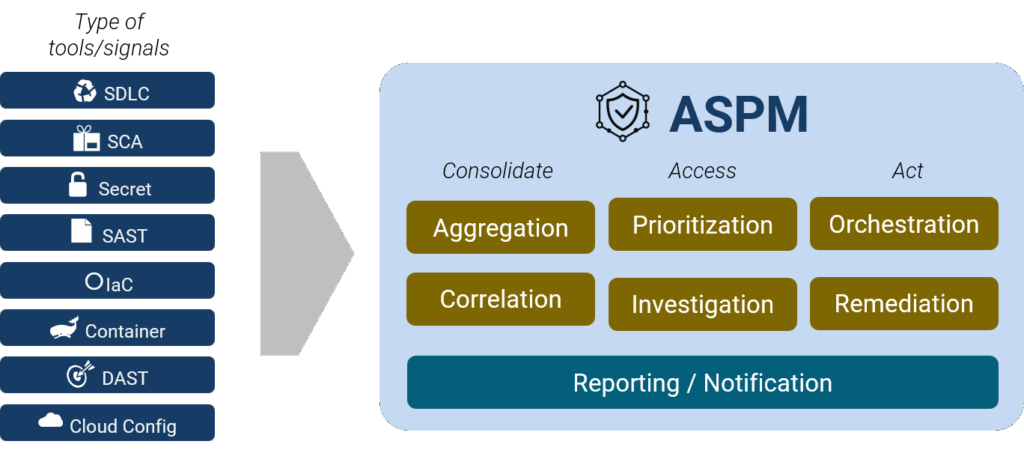
A modern ASPM system offers a range of central functions that together enable holistic security management:
- Aggregation
Collects findings from all relevant sources, from SAST and DAST to cloud security, in a central platform. - Correlation
Links related risks from different tools or pipeline stages, avoids duplicates, and identifies correlations. - Prioritization
Evaluates vulnerabilities not only by criticality but also by business relevance, runtime context, and threat landscape. - Investigation
Shows where a problem truly originated and how it can be resolved efficiently and sustainably. - Orchestration
Automates workflows between teams, triggers ticketing processes, notifies stakeholders, and tracks progress. - Remediation
Provides developers with context-sensitive assistance directly in the IDE or in the pull request, effectively closing sources of errors.
Holistic Solution Instead of a Patchwork
ASPM does not contradict existing security tools; on the contrary, it connects, orchestrates, and improves their effectiveness. The goal is not to generate „more alerts” but to manage the actual reduction of risk.
Instead of isolated measures, a continuous, holistic security process is created across all phases of the Software Development Lifecycle. Security measures are transparently anchored, prioritized, and automated.
Clear Benefits for All Stakeholders
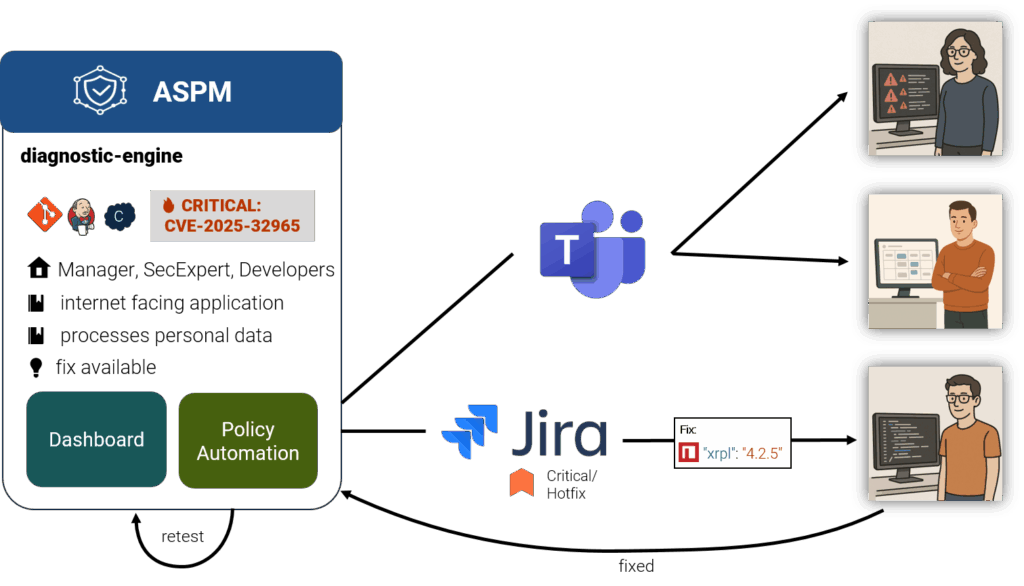
An ASPM system not only enhances technical security but also provides tangible relief and efficiency gains for all involved roles within the company. Security vulnerabilities are automatically detected, assessed contextually, and directly forwarded to the relevant individuals without detours or manual escalations. Developers receive specific remediation instructions directly within their familiar environment, such as through pull request comments or ticketing systems. The recommended solutions are tailored to the respective project and include, for example, specific version information for vulnerable dependencies. Project managers clearly see which vulnerabilities are truly critical for their applications, including risk assessment, progress tracking, and responsibilities. Simultaneously, security teams gain time and overview, as they no longer have to manage each case individually: Coordination runs automatically, escalation is regulated, and the overall status of the security situation is visible at all times. This creates a transparent, consistently controlled security process that avoids friction losses, reduces duplication of effort, and specifically involves all participants where it makes sense.
An ASPM system provides noticeable advantages for every role in the company:
- Development teams save time through concrete recommendations for action in familiar tooling.
- Security teams gain an overview and can concentrate on strategically important tasks.
- Project managers and executives receive a clear risk assessment and full transparency.
Why ASPM is relevant now
In many companies today, there is one IT security expert for every 50 developers. At the same time, the number of security messages is growing daily. Without central control, this is no longer manageable.
ASPM delivers exactly that: clarity, structure, and automation. Risks are identified and addressed where they arise, without additional overhead.
Conclusion: ASPM as the key to more security with less effort
Application Security Posture Management is not just another security tool; it is the orchestrator that brings your existing measures together and makes them effective. For companies that want to maintain an overview, use resources effectively, and manage security holistically, ASPM is the next logical step.
More overview. Less effort. Higher security.
Act now: More security with mgm Atlas
Would you like to identify security risks faster, automate processes and specifically relieve your development teams? With mgm Atlas, our own Application Security Posture Management system, we offer you a field-tested solution developed by security experts, designed for complex development realities. Flexible integration, data protection compliant and individually adaptable.