
Business Impact Analysis

The Business Impact Analysis (BIA) answers the central question of any emergency management plan: Which business processes are so critical that their failure would seriously jeopardize the company, and how quickly must they be restored? mgm security partners conducts the BIA in a structured and transparent manner, using a methodologically sound approach based on the BSI 200-4 standard and ISO 22301. The result provides a solid foundation for all subsequent steps in business continuity management.
Without a BIA, there can be no effective BCM: Continuity strategies, emergency plans, and drills require clear prioritization. Only a BIA provides the tolerable downtime (RTO, MTA) and the maximum tolerable data loss (RPO), upon which all further measures are based.
Background
What the BIA Does
Business impact analysis is the systematic examination of the consequences that a business process outage has for a company. It identifies time-critical processes, determines their dependencies on IT systems, personnel, service providers, and resources, and establishes how long an outage can be tolerated before the damage becomes unacceptable.
The key time and recovery objectives are derived from the BIA: the target recovery time objective (RTO), the maximum tolerable downtime (MTA or MTPD), and the maximum tolerable data loss (RPO). These metrics form the foundation upon which continuity strategies, emergency plans, and drills are built as part of our BCM support.
RPO, RTO, and MTA at a Glance
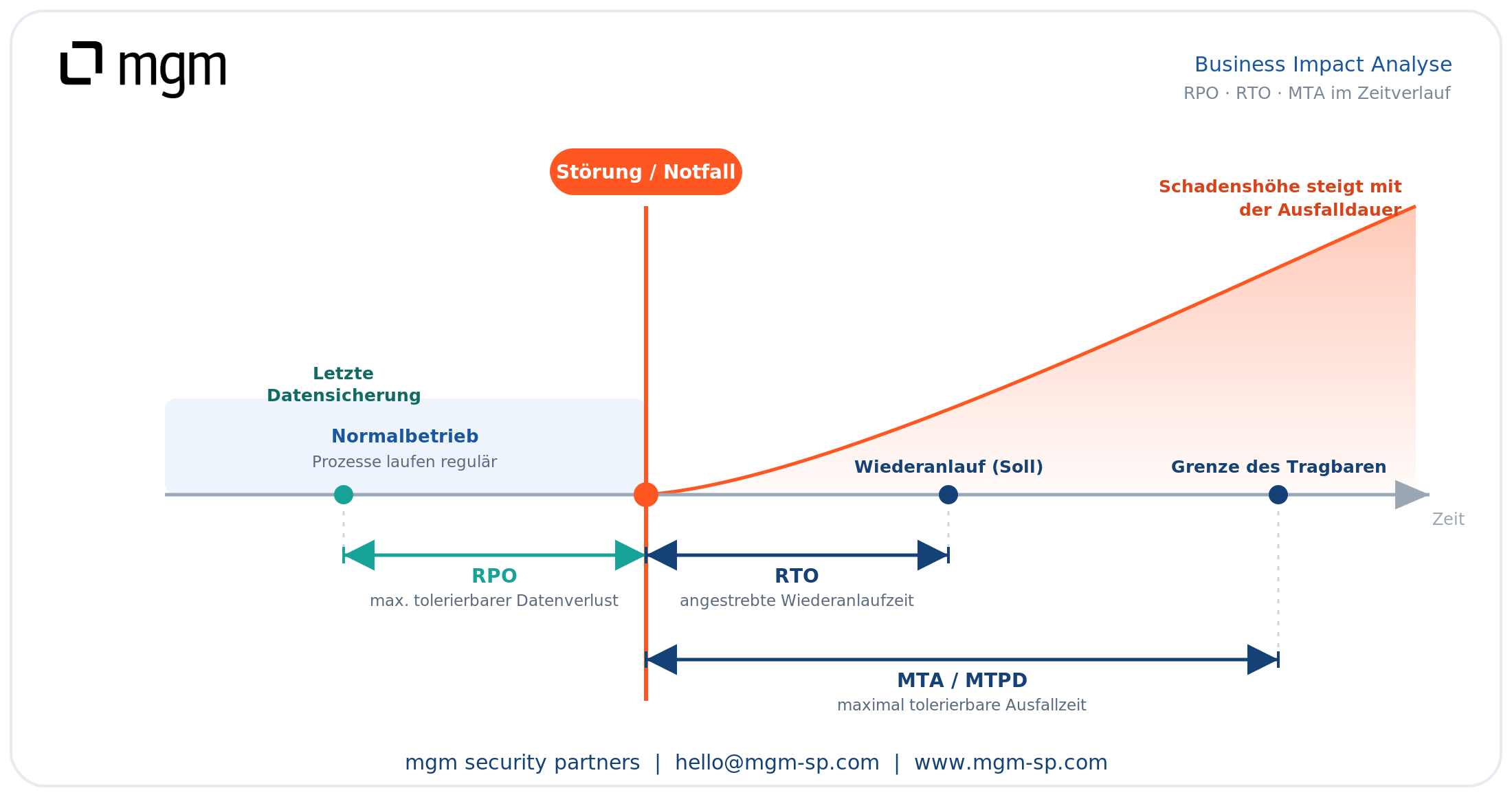
The key findings of a BIA can be illustrated using the timeline of an outage. They determine how much data loss is tolerable and how quickly a process must be restored.
RPO limits data loss prior to the failure, while RTO and MTA limit the duration of the outage afterward.
The challenge
- It is unclear which processes need to be restarted first in the event of an emergency
- Acceptable levels of downtime and data loss are not documented
- Dependencies on IT, personnel, and service providers are not transparent
- Emergency measures were established without a clear prioritization
- BSI 200-4, ISO 22301, and DORA require a traceable BIA
- There is a lack of time and methodology for interviews, evaluation, and documentation
Our Added Value
- Structured assessment of critical processes through workshops and interviews
- Transparent calculation of RTO, MTA, and RPO for each process
- Clear presentation of dependencies and resource requirements
- Methodology based on BSI 200-4 and ISO 22301, appropriately scaled
- Validated documentation as evidence for audits and regulatory compliance
- Seamless Transition in Continuity Strategy and Emergency Planning
An Overview of Our BIA
From defining the scope of the review to data collection and analysis, all the way to audit-ready documentation. We tailor the scope and level of detail to your organization and your regulatory requirements.
1 - Scoping & Preparation
A clear framework before the actual analysis begins.
- Defining the Scope of Analysis
- Selection of Relevant Processes and Points of Contact
- Definition of Damage Categories and Scales
- Coordination of the Methodological Approach
2 - Process Mapping
Structured documentation of critical business processes.
- Interviews and workshops with the academic departments
- Documentation of Processes and Responsibilities
- Identification of Required Resources and Systems
- Identification of Dependencies and Interfaces
3 - Impact Assessment
Assessment of the consequences of a failure over time.
- Assessment of Financial and Non-Financial Damages
- Analysis of Legal and Regulatory Implications
- Analysis of Damage Development Over the Duration of the Outage
- Derivation of Criticality by Process
4 - Time & Resource Requirements
The key metrics for your BCM.
- Calculation of RTO and MTA/MTPD per Process
- Setting the RPO as a Backup Target
- Determining Minimum Resource Requirements
- Determining the Restart Level (Emergency Operation)
5 - Documentation & Report
Reliable test results that stand the test of time.
- Consolidated BIA Report with Prioritization
- Clear presentation of key figures
- Recommendations for Next Steps
- Verifiable documentation for audits
6 - Transition to BCM
The BIA as a starting point, not an end in itself.
- Development of Continuity Strategies
- Basis for Emergency and Recovery Plans
- Input for Emergency Drill Scenarios
- Integration with our BCM support
Key BIA Metrics Explained
BIA relies on several key metrics that recur throughout the entire BCM process. These metrics determine how much data loss and downtime a critical process can tolerate, and they serve as the benchmark for backup strategies, recovery planning, and investment decisions. We determine these metrics in collaboration with your business units and document them in a transparent manner.
- RTO (Recovery Time Objective): The target recovery time within which a process should be available again after a failure.
- MTA / MTPD: Maximum tolerable downtime, beyond which a failure would cause unacceptable damage.
- RPO (Recovery Point Objective): The maximum tolerable data loss; the period prior to the failure during which data loss is still acceptable. A guideline for backups.
- Criticality: Classification of processes based on the severity and speed of the effects of a failure.
- Dependencies: The IT systems, personnel, service providers, and resources required for a process to function; without them, the process cannot operate.
What Our BIA Covers
We conduct the analysis in collaboration with your departments and deliver reliable, documented results to serve as the foundation for your business continuity management.
- Scope of the Study and Methodology
- Interviews and workshops with the academic departments
- Identification of Critical Processes and Dependencies
- Assessment of the Impact Over the Duration of the Outage
- Calculation of RTO, MTA, and RPO for Each Process
- A comprehensive BIA report with prioritization and recommendations
From Preparation to Reliable Results
We conduct the BIA efficiently and without placing an unnecessary burden on your departments. We primarily work remotely, though on-site workshops are available by arrangement.
- 1 – Preparation: Defining the scope of the analysis, identifying categories of damage, and selecting points of contact.
- 2 – Data Collection: Structured interviews and workshops to document processes, dependencies, and resources.
- 3 – Analysis & Assessment: Assessing the impact and determining the RTO, MTA, and RPO, as well as the criticality of each process.
- 4 – Report & Handoff: Consolidated BIA report with prioritization, recommendations, and handoff to BCM planning.
BIA in conjunction with your BCM
The business impact analysis is the first step. We incorporate its results directly into the other components of business continuity management.
BCM Support
The BIA results are used to develop business continuity strategies and emergency plans. Our BCM support helps you establish your management system in accordance with BSI 200-4 and ISO 22301.
Emergency Drills for BCM
The critical processes identified in the BIA provide the scenarios. We plan and facilitate the appropriate emergency and crisis drills.
DORA & NIS2 Consulting
DORA and NIS-2 require a thorough BIA. We determine the extent to which your organization is affected and align the requirements with your analysis.
Methodology, Experience, and Connectivity
- Over 25 years of experience in IT security consulting
- BIA Methodology in Accordance with BSI Standard 200-4 and ISO 22301
- ISO 27001 certified and TISAX-compliant
- Experience from projects for government agencies and operators of critical infrastructure
mgm security partners covers the full spectrum of IT security, from consulting to security analyses and penetration tests to training. Our BIA is not a standalone document, but rather the first building block of a comprehensive BCM. We are ISO 27001 and TISAX certified and work for the BSI, other government agencies, and KRITIS operators, among others. We seamlessly integrate the results into our BCM support.
Business Impact Analysis: Quick Answers to Your Questions
What is the difference between BIA and risk analysis?
The BIA examines the consequences of a failure, regardless of the cause: it asks how severe the impact will be and how quickly a process must resume. Risk analysis, on the other hand, examines the causes and probabilities of threats. The two complement each other. In BCM, the continuity strategy is based on both; the BIA provides the prioritization and timeframes.
What do RTO, MTA, and RPO stand for?
RTO (Recovery Time Objective) is the target recovery time for a process. MTA or MTPD is the maximum tolerable downtime beyond which the damage becomes unacceptable. RPO (Recovery Point Objective) is the maximum tolerable data loss and thus the benchmark for backup frequency. These three metrics are the most important findings of the BIA.
How long does a BIA take?
That depends on the number of processes being analyzed and the size of the organization. A focused BIA for the most critical areas can often be completed in a few weeks. We take a risk-based approach and focus first on the processes with the greatest potential for damage, rather than assessing everything at once.
Is a BIA absolutely required for DORA or NIS-2?
A thorough BIA is, in fact, a prerequisite for audit-proof business continuity management, as required by DORA and NIS-2. Without prioritizing critical processes and determining acceptable downtime, continuity strategies and tests cannot be justified in a transparent manner. We’ll help you determine how these regulations specifically affect your organization through our DORA and NIS-2 consulting services.
Who is required to participate in the BIA?
The key information lies within the business units. We conduct interviews and workshops with the process owners and involve IT as well as relevant service provider contacts. We minimize the burden on your employees by preparing and facilitating the data collection in a structured manner.
What happens after the BIA?
The BIA is the starting point, not the goal. Based on its results, we derive continuity strategies and develop emergency and recovery plans. We then test these plans through emergency drills. We incorporate all of this into our BCM support, ensuring that analysis, planning, and testing are seamlessly integrated.