
AI Governance

Artificial intelligence is transforming how organizations operate and compete. However, implementing AI without a governance framework creates regulatory risks, data risks, and reputational damage. mgm security partners helps you move forward in a way that ensures your AI is productive, compliant, and secure from the ground up—through risk analysis, a tailored governance framework, and regulatory compliance.
The EU AI Act is already in effect. As of February 2, 2025, prohibited AI practices are banned, and there is a requirement for AI literacy. Additional requirements will take effect in phases through 2027. Anyone using AI should establish a structured governance framework now.
DeepDive
What is AI Governance?
AI governance is the structured framework of policies, processes, and responsibilities that an organization uses to manage, safeguard, and ensure the traceability of AI use. It clarifies which AI applications are permitted, how they are approved, what data they are allowed to use, and who is responsible. The goal is not to slow down innovation, but to enable it safely and in compliance with regulations.
The regulatory framework has taken shape with the EU AI Act (Regulation (EU) 2024/1689). The regulation entered into force on August 1, 2024, and requires companies to adopt a risk-based approach to AI. At the same time, the GDPR and established ISO/IEC standards remain relevant. AI governance integrates these requirements into your existing security and risk management framework, rather than treating them in isolation.
The challenge
- AI tools are being implemented without clear security guidelines
- New AI tools and features are emerging faster than governance can keep up
- Sensitive data is leaked through unverified models or tools
- Non-compliance with the GDPR, the EU AI Act, and ISO standards
- Lack of internal expertise to manage AI effectively over the long term
- Shadow AI: AI Use Outside of IT Control
Our Added Value
- Structured AI governance frameworks tailored to your organization
- AI governance integrated into your risk management, not added as an afterthought
- Clear guidelines that enable innovation rather than hinder it
- Regulatory Readiness for the Requirements of the EU AI Act
- Practical support from strategy through implementation
- Effective integration with existing standards such as ISO 27001 and ISO/IEC 42001
The Risk-Based Approach of the EU AI Act
The EU AI Act classifies AI systems into four risk categories. This classification determines specific obligations, ranging from basic transparency to comprehensive requirements for risk management, data, and human oversight. Classifying your AI applications is therefore always the first step.
- Unacceptable Risk (Prohibited): AI practices that have been prohibited since February 2, 2025, such as social scoring, manipulative systems, or emotion recognition in the workplace.
- High Risk: Systems that have a significant impact on safety or fundamental rights, with extensive obligations regarding risk management, data quality, logging, human oversight, and conformity assessment.
- Limited risk: Systems designed for interaction or output, such as chatbots or AI-generated content, which are primarily subject to transparency and labeling requirements.
- Minimal risk: The majority of AI applications, such as spam filters or AI in standard software. No additional obligations; voluntary codes of conduct are recommended.
Our AI Governance Services
Six coordinated components, ranging from risk analysis of your AI applications to the governance framework, compliance, training, and integration into your existing ISMS.
1 - AI Risk Assessment
: Identify AI use cases and classify them by risk.
- Inventory of all AI applications, including Shadow AI
- Classification into the risk categories of the EU AI Act
- Assessment of Data, Provider, and Model Risks
2 - Governance Framework
: Establishing guidelines, approval processes, and responsibilities.
- AI Guidelines That Enable Innovation Rather Than Hinder It
- Approval and Authorization Processes for New AI Tools
- Clear Roles, Responsibilities, and Accountability
3 - Secure AI Usage
: Ensuring the technical security of AI solutions.
- Data Protection and Access Controls for AI Systems
- Protecting Sensitive Data from Unverified Models
- Traceable Audit Trails for AI Deployment
4 - Compliance Readiness
: Align AI operations with the GDPR, the EU AI Act, and ISO standards.
- Alignment with the requirements of the EU AI Act
- Alignment with the GDPR and Data Protection Requirements
- Alignment with ISO/IEC standards, particularly ISO/IEC 42001
5 - Awareness & Training
: Empowering management and staff.
- Compliance with the AI Competence Requirement under the EU AI Act
- Targeted Training for Management and Teams
- Practical Guidelines for Safe AI in Everyday Life
6 - Governance Integration
: Embed AI governance into ISMS and risk management.
- Integration with an existing ISO 27001 ISMS
- Integration into Risk Management and Reporting Processes
- No duplicate structures—instead, leverage existing processes
We understand AI not only from a regulatory perspective, but also from a technical one
AI governance remains a mere formality if no one can truly audit the AI applications in use. This is precisely where our technical expertise comes into play: We’ve been providing application security for over 20 years, and with our LLM Security Testing, we conduct in-depth audits of AI and LLM applications—examining their architecture, code, and operations.
Traditional penetration tests quickly reach their limits when it comes to AI-based applications, as large language models do not operate deterministically. We rely on a systematic white-box analysis that leverages architectural and implementation knowledge, guided by the OWASP LLM Top 10 and MITRE ATLAS. This makes the effectiveness of your governance measures technically verifiable, rather than merely claimed.
Your Path to Trustworthy AI Governance
A structured, actionable path—from classifying your AI applications to achieving verifiable, continuously improved operations. AI governance is a lifecycle, not a one-time project.
Risk assessment, the governance framework, secure implementation, compliance, and training, as well as integration and ongoing operations, are all interlinked and are continuously improved.
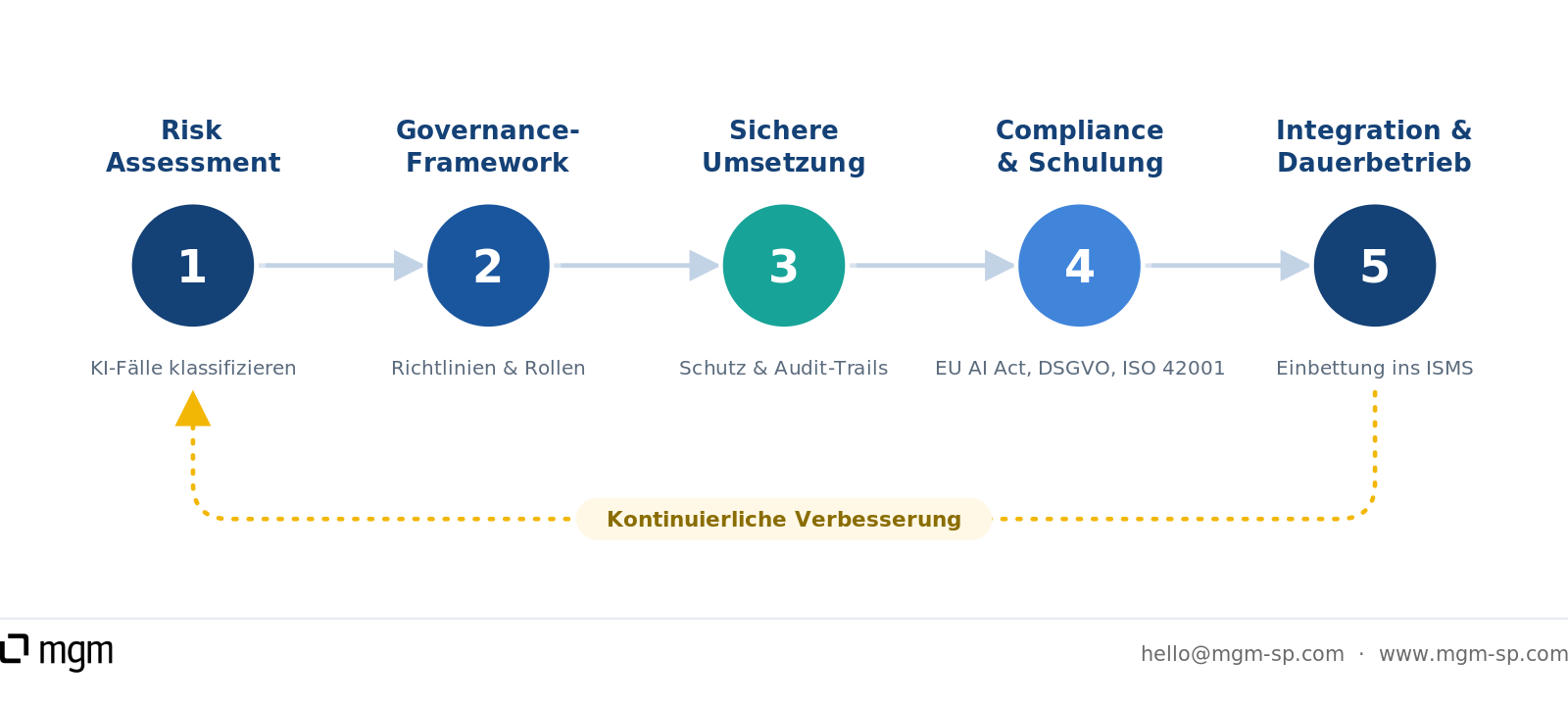
An Overview of the Five Phases
We'll guide you through every stage, step by step and at your own pace.
- 1 – Risk Assessment: Identify AI applications, including shadow AI, and classify them according to the risk categories set forth in the EU AI Act.
- 2 – Governance Framework: Develop guidelines, approval processes, and clear responsibilities.
- 3 – Secure Implementation: Ensure the secure use of AI through data protection controls, access management, and audit trails.
- 4 – Compliance & Training: Ensure compliance with the EU AI Act, the GDPR, and ISO/IEC 42001, and train teams.
- 5 – Integration & Continuous Operation: Embed AI governance in the ISMS and continuously improve it.
ISO/IEC 42001 and ISO 27001 as a Foundation
An existing ISO 27001 ISMS provides the ideal foundation for AI governance. Risk management, policies, access controls, and documentation are already systematically integrated into the system, allowing a large portion of AI requirements to build upon existing processes.
- ISO/IEC 42001 (certifiable): The international standard for AI management systems (AIMS). It provides a certifiable framework specifically designed for the responsible use of AI and complements ISO 27001 perfectly.
- ISO/IEC 27001: The established ISMS serves as the foundation for risk management, guidelines, and evidence, upon which AI governance is directly built.
- Our Approach: We align your AI governance with ISO/IEC 42001, integrate it with your ISMS, and build only what is truly missing for the responsible use of AI.
From Governance to Technical Depth
AI Governance determines which measures are necessary. We implement them and conduct technical reviews, ranging from application security to specialized LLM security testing.
LLM Security Testing
Test AI and LLM applications using a white-box approach, based on the OWASP LLM Top 10 and MITRE ATLAS.
Application Security
Embed application security in a structured way throughout the development process, from threat modeling to secure coding to secure architecture.
Information Security
Pragmatic solutions for ISMS, compliance, and awareness to ensure your information security is optimally positioned.
Why mgm security partners?
- 25+ Years of Enterprise Security Consulting
- Over 20 Years of Application Security and LLM Security Testing
- 100% led by senior security experts
- Compliance with the EU AI Act, the GDPR, and ISO/IEC 42001
We have expertise in both the regulatory aspects of AI and its technical implementation, drawn from over 25 years of enterprise security consulting for banks, insurance companies, industrial firms, and software manufacturers. Rather than duplicating governance on paper, we integrate it into your existing risk management framework and transform abstract obligations into tangible, practical processes.
AI Governance Consulting: Quick Answers to Your Questions
Does the EU AI Act even apply to us?
Generally speaking, yes, as soon as AI is used in your company. The ban on certain AI practices and the requirement for AI competence have been in effect since February 2, 2025. The scope of your other obligations depends on the risk class of your AI applications. We’ll conduct an assessment to determine which systems you use and what requirements apply to them.
What is Shadow AI, and why is it a problem?
"Shadow AI" refers to AI tools that employees use without authorization and outside of IT oversight. The risk: Sensitive data ends up in untested models without data protection or security controls. Our risk assessment identifies this usage and translates it into clear, actionable rules.
Is AI Governance Holding Us Back from Innovation?
No, on the contrary. Good governance provides clarity on what is permitted and how new tools can be approved quickly. Our guidelines are designed to enable innovation rather than hinder it, with defined parameters rather than blanket bans.
Do we absolutely need an ISO 27001 ISMS for this?
No, but it helps significantly. An existing ISMS provides risk management, guidelines, and documentation that serve as the foundation for AI governance. If you don’t yet have an ISMS, we’ll set up a streamlined AI governance framework and integrate it with ISO 27001 or the AI management standard ISO/IEC 42001 as needed.
What are the consequences of violating the EU AI Act?
The range of fines is tiered. Prohibited practices are subject to fines of up to 35 million euros or 7% of global annual revenue; violations of other obligations are subject to fines of up to 15 million euros or 3%; and providing false information to authorities is subject to fines of up to 7.5 million euros or 1%. This means the upper limit exceeds that of the GDPR.
What does a typical AI governance project look like?
We start with a risk assessment that identifies and classifies your AI applications. Based on this, we develop a suitable governance framework, ensure its technical implementation, establish compliance, and train your teams. Finally, we embed AI governance into your day-to-day operations and your ISMS.